Forja
Brand and data are fictional, to protect the client.
The problem
The shop wrote down jobs, payments and what it was owed in notebooks and spreadsheets: it was hard to know what was pending delivery or payment.
What was built
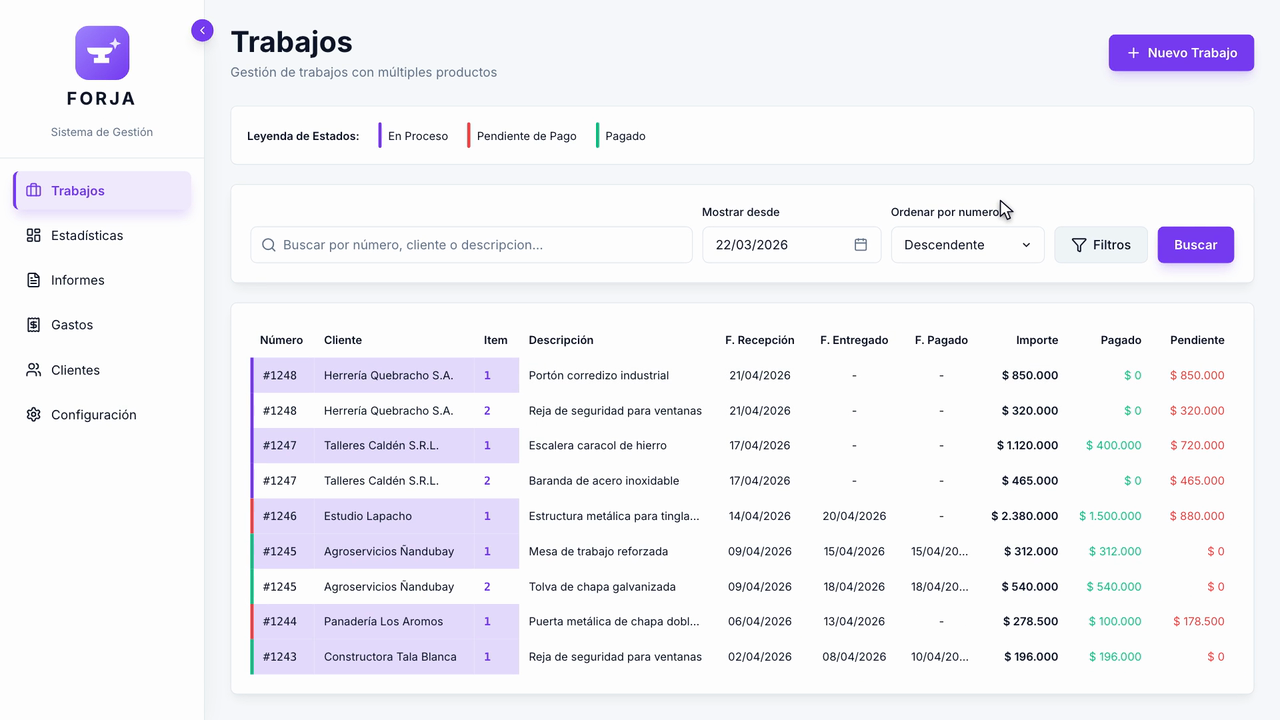
A system to enter orders with their items and follow each one's status (in progress, awaiting payment, paid), record expenses, generate PDF reports by date or client, and see the cash position and what is still owed.
Technical details
Electron with React and TypeScript. The UI has no access to Node (contextIsolation and a typed preload): everything goes through about 60 IPC handlers in the main process, with one service per entity.
It works offline: SQLite (better-sqlite3) is the source of truth, and Supabase acts as backup and sync. Each change is uploaded in the background, and a scheduled backup that was missed is recovered on startup. Sync is incremental, with soft deletes, and in a conflict the most recent write wins.
The workshop’s historical data lived in an Access database. A script migrated it with mdb-reader, normalizing dates and text, all inside transactions. Reports are generated as PDF, and the Windows executable is built on GitHub Actions.
Technologies
- Electron
- React
- TypeScript
- Tailwind CSS
- SQLite
- Supabase